
February 17, 2026
How Feasibility Prediction Transforms Enzyme Discovery Through Data

Your company's pipeline includes numerous synthetic routes for new APIs, each with multiple steps where biocatalysis could work. Your R&D budget allows you to test maybe three pathways. But traditional enzyme discovery operates on trial-and-error, typically demanding months or years of investment and no guarantee of success. So which routes do you choose?
A chemist can determine whether a reaction type might work with an enzyme based on literature and functional groups. However, chemical intuition doesn't always translate to biological success. You cannot visualize whether a complex, functionalized API will actually fit into a protein's 3D active site. If it doesn't enter, the reaction won't happen—no matter how promising the chemistry looks.
Traditional enzyme discovery statistics are stark: success rates below 40% for general enzyme discovery, dropping below 10% for non-natural substrates. You need a solution to transform how you evaluate routes to dramatically transform your chance of success — and protect your budget.
Learning from Failure to Uncover a New Approach
Pharmaceutical and generics companies face a particularly thorny version of this lack of visibility into the potential for biocatalysis in established chemical synthesis routes. Literature might tell you that certain reaction types could be done with enzymes. But that doesn't answer the key question: which routes in your portfolio have the highest probability of success?
A traditional approach demands significant resources before you even know if you have activity, creating an unsustainable model of wasted time and investment. However, if you don't proceed at all, you miss opportunities for greener, simpler, and more cost-effective manufacturing.
Without data to inform your decision-making, you're gambling with your R&D budget. We know this challenge firsthand.
The Feasibility Engine emerged from direct experience navigating projects that appeared viable on paper but failed because there were no enzymes that could accommodate the substrate or because it could not access the enzyme’s active site. When Zymvol was founded in 2017, our overall project success rate was just 53%. We needed a fundamental solution, and that solution transformed our overall success rates to 85%.
How Zymvol’s Assessment Process Eliminates Guesswork
In 2019, we recognized a pattern in our own work. We were taking on projects without proper evaluation. Our early failure rates weren’t due to technical capability, but a lack of upfront analysis to verify potential routes.
We introduced the Feasibility Assessment—a rapid, preliminary study designed to predict a project's chances of success. This quick study enables you to assess how likely a route of synthesis can be replaced by biocatalysis before committing a major investment.
High confidence predictions meant our clients could proceed with a clear understanding of the likelihood of a positive outcome from biocatalysis. Routes assessed as high risk meant our team could cut their losses early, allowing us to reallocate resources to more promising projects.
The results validated the approach: Our enzyme discovery success rates jumped from 38% to 78%, enzyme optimization climbed from 69% to 93%, and overall project success soared from 53% to 85%.
The Feasibility Engine: Assessing Complete Portfolios
Single-project feasibility assessments are valuable, but your company has entire portfolios requiring evaluation and prioritization. The Feasibility Engine applies our proven methodology to analyze your complete pipeline rather than assessing reactions in isolation.
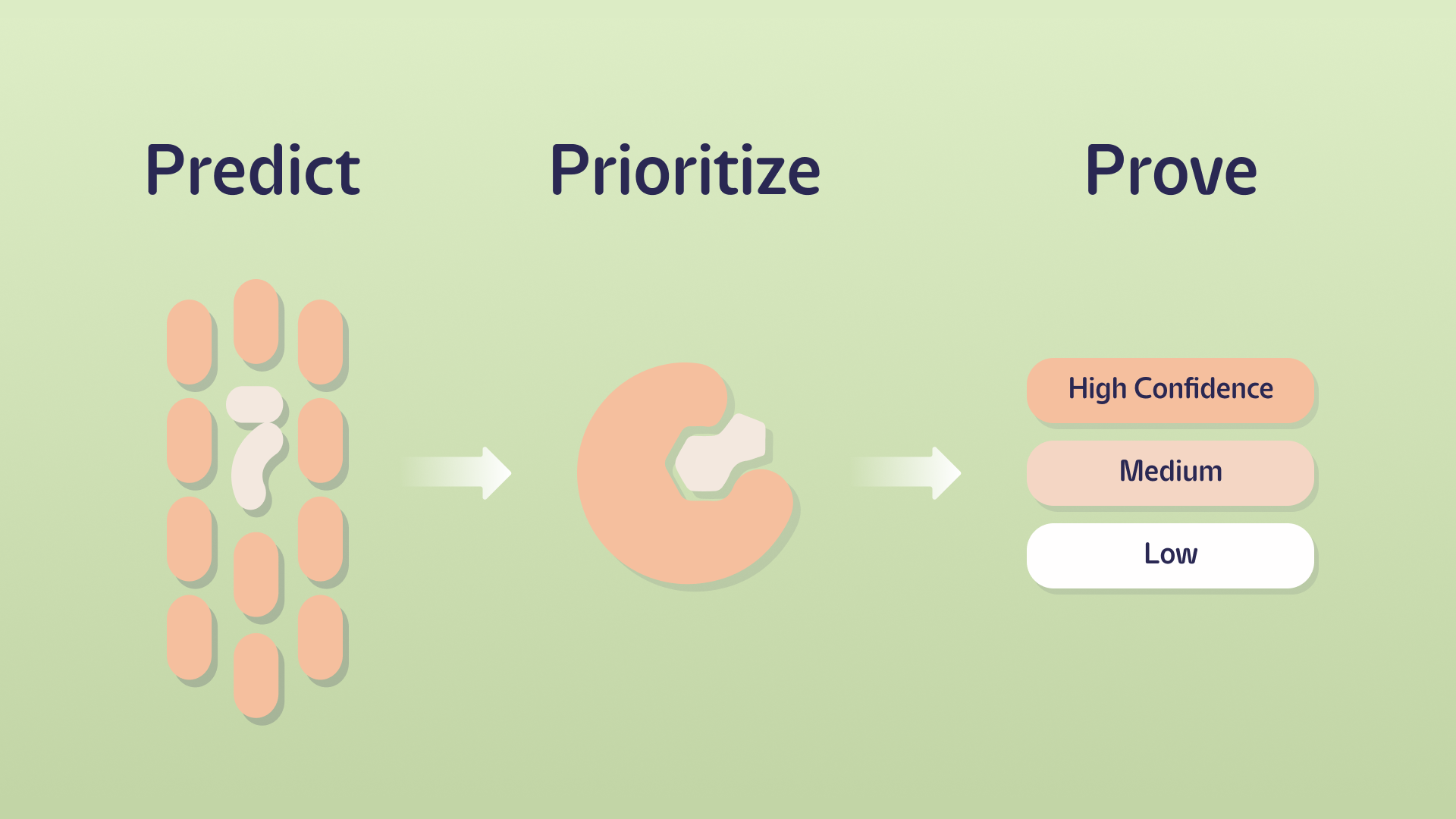
The Feasibility Engine functions through our Predict-Prioritize-Prove framework:
Predict: We evaluate the available enzyme sequence space for your reaction type. Are there millions of potential natural enzymes that could catalyze this transformation? Or are your options limited?
Prioritize: We build 3D structural models of enzyme families and computationally model how your substrate fits into active sites. More than a superficial screening, this is a comprehensive evaluation to identify structural compatibility, clashes, and whether the chemistry can actually occur.
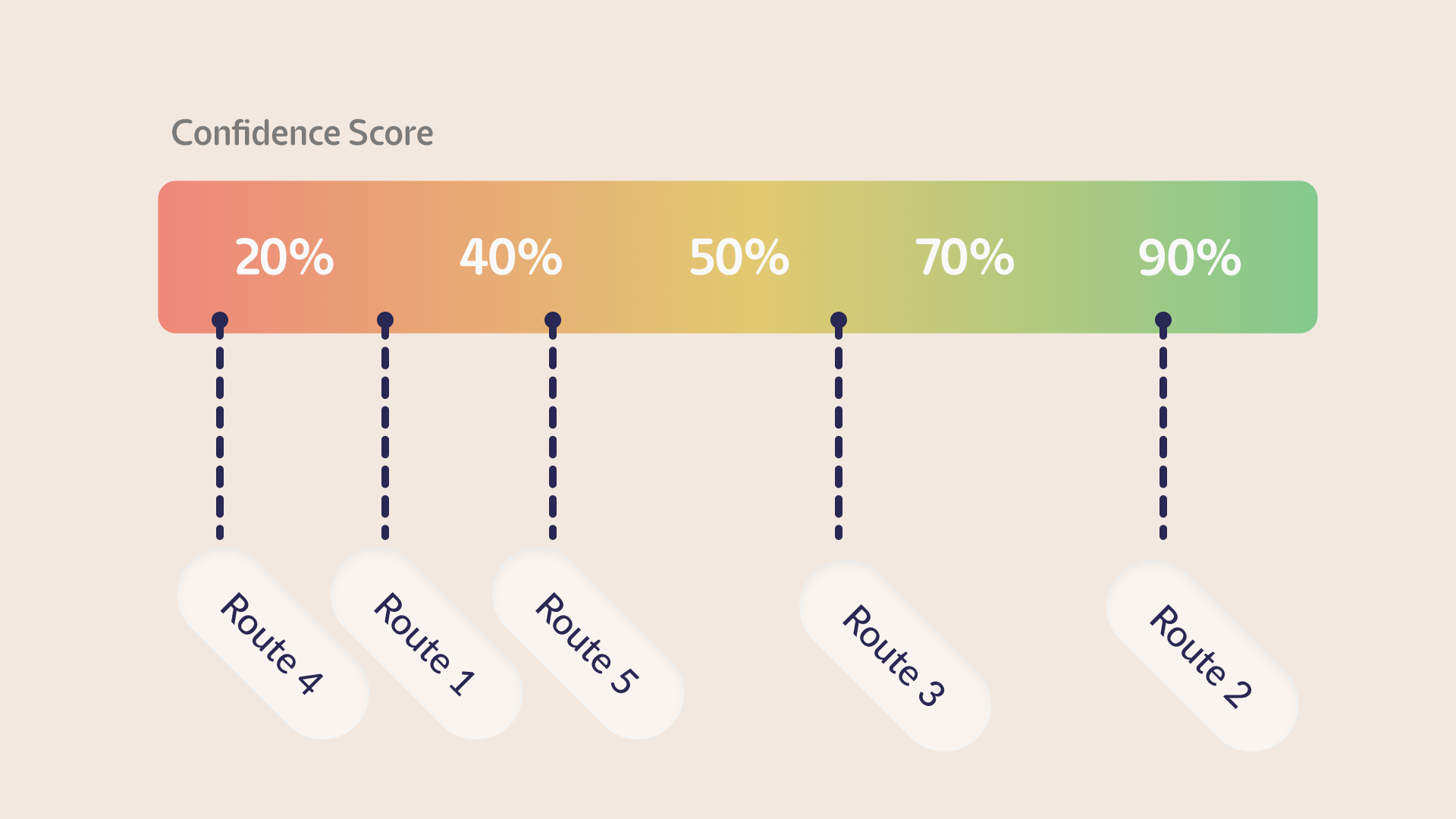
Prove: We rank all routes with confidence scores based on structural analysis, creating a data-driven hierarchy outlining the highest to lowest probabilities of success. You receive a single strategic report that provides the complete picture of your entire portfolio.
The Feasibility Engine doesn't just screen; it assesses the full breadth of your options. We combine sequence space availability with deep structural modeling to give you both a "yes/no" viability answer and the "compared to what" prioritization insight.
With the Feasibility Engine, you can clearly identify the chemical pathways most compatible with biocatalysis. This allows you to transform a complex R&D challenge into a prioritized, data-driven roadmap — delivered in as fast as one week for up to 3 transformations. (Larger portfolios require additional time for comprehensive structural evaluation.)
Hyperrealistic Simulations Look Beyond Chemical Intuition
The technical foundation of the Feasibility Engine lies in structural modeling. We take enzyme sequences and build virtual 3D structures. Then, we apply a physics-AI approach to computationally model how your substrate fits into the enzyme's active site.
These simulations reveal what traditional chemical intuition cannot: physical clashes, spatial constraints, and whether the chemistry can structurally occur. You don't need to model the entire enzyme space — screening even 10% of the available sequences can provide definitive answers about a route's viability. This smart sampling approach enables rapid assessment without sacrificing accuracy.
To be successful, we need viable 3D structural models as the foundation, often derived from X-ray crystallography data. This is why having good structural models is critical. If you don't have a good structural model of the enzyme, you don't have anything to start with for hyperrealistic modeling.
For GO decisions, we evaluate large libraries of available sequences, including available structural 3D models. For sequences evaluated as NO-GO, we identify low or no biocatalyst opportunities, or flag those with high technical risk. This allows you to shift from decision-making that’s based on hope to acting on real, evidence-based insights.
Why Identifying Dead Ends Is Just as Valuable as Success
NO-GO decisions deliver real capital efficiency. If the assessment reveals a low chance of success, you can end the project at the initial stage—before a costly full campaign begins. Those resources can then be reallocated to more promising opportunities in your portfolio.
Understanding both viable and non-viable options across your entire portfolio transforms guesswork into strategy.
Transform Multiple Potential Routes into Focused Success
A generics company came to us with classic portfolio paralysis. They had multiple chemical routes to produce APIs but were unsure which to pursue with biocatalysis, which resulted in no forward progress.
The Feasibility Engine evaluated all their potential pathways and ranked them by Confidence Score, resulting in a top-ranked pathway that clearly stood out. The client selected it, and we moved to enzyme discovery. Notably, no prior enzyme was known for this specific application. We found 20 active enzymes in two months, and the best enzyme was taken to optimization.
Our partnership continues through iterative optimization. Through three rounds of enzyme engineering, we've achieved fourfold improvement in conversion with 99% activity. Total timeline from initial assessment to optimized enzyme: under six months.
This demonstrates end-to-end capability from assessing your options through discovery and engineering. The "pre-flight simulation" value of the Feasibility Engine is clear: structural modeling in computers to represent reality before committing to experiments.
How to Shift from Portfolio Paralysis to Confident Action
The Feasibility Engine converts biocatalysis from resource-intensive trial-and-error into a data-driven, strategic tool. Chemical intuition provides a starting point, but structural modeling provides certainty. Together, they transform an impossible set of potential options into an informed conclusion.
The track record speaks for itself. Beyond transforming our own project success from 53% to 85%, this methodology has proven its value across more than 100 projects. For pharmaceutical enzymes specifically, when we say a reaction can be done, we will find an enzyme to do it more than 90% of the time.
You don't have to gamble with your R&D budget anymore. With clear Confidence Scores ranking your entire portfolio, the Feasibility Engine delivers both the speed and accuracy needed to make biocatalysis a predictable—and more profitable—process.
Ready to take the next step? Click here for a look at the Feasibility Engine in action.
You might be interested in


Start your Evolution
Create new products and processes, adapt existing ones or develop completely new biochemistry. Zymvol is here to guide you in any stage of your journey.
Go to solutions