
Mapping distal mutations allowed us to extend the enzyme’s operational life by 40-fold, a critical factor for long-term industrial cycles.
Pharmaceutical
Optimizing pharma manufacturing with a co-factor regeneration system
The challenge
A pharmaceutical manufacturer was facing a pretty common problem in its field: their existing biocatalytic system was heavily reliant on an expensive, non-renewable co-factor that was consumed during the reaction and generated inhibitory byproducts.
This single-use approach made the chemical synthesis too inefficient and costly to be viable at scale. To move forward, the client needed a more sustainable and cost-competitive solution that could drastically reduce raw material overhead without sacrificing reaction yield.
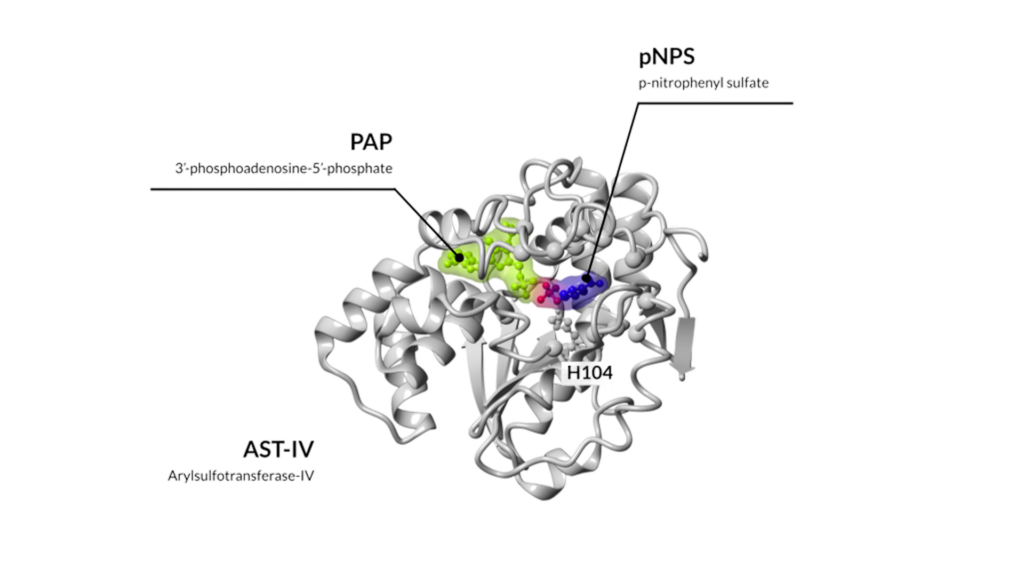
Structural model of arylsulfotransferase-IV (AST-IV) binding pocket.
Includes the PAP cofactor (green) and pNPS substrate (blue/purple) in the active site region near position H104.
Our solution
Zymvol’s team designed and implemented a novel enzymatic synthesis featuring an integrated co-factor regeneration system, allowing continuous in situ recycling of the cofactor rather than one-time use.
This cofactor recycling solution was built on a multi-enzyme regeneration cascade that converts low-cost substrates into active cofactor within the reaction vessel, maintaining high catalytic turnover while preventing inhibitory byproduct accumulation and eliminating the need for constant replenishment.
Results & impact
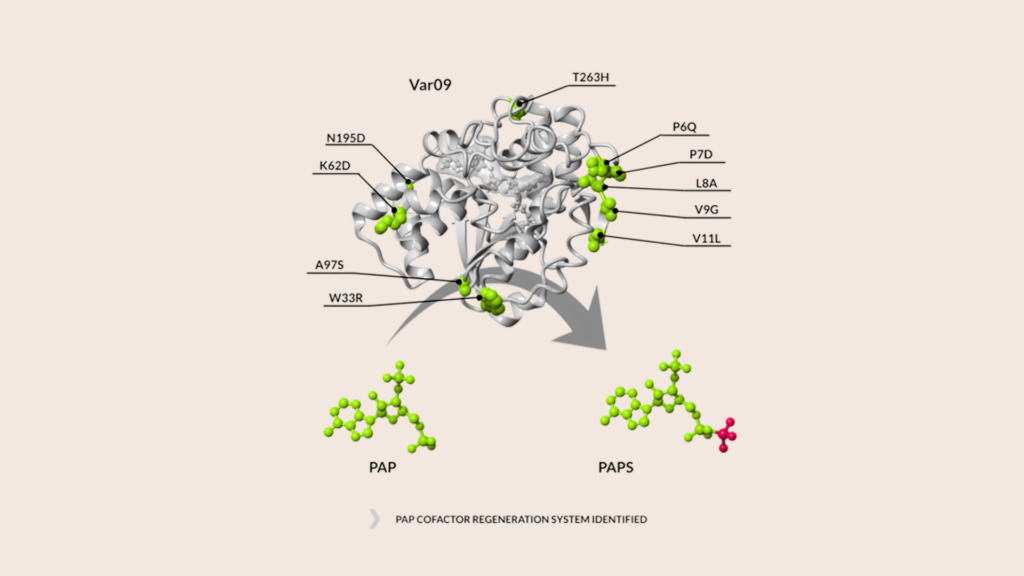
Structural model of AST-IV variant Var09.
Includes predicted targeted mutation sites (green) to improve PAP cofactor regeneration system to yield PAPS.
- Increased product formation
The shift from a resource-limited batch process to a continuous regeneration cycle led to a massive boost in productivity. By maintaining optimal co-factor levels throughout the reaction, the system achieved 7x more product formation compared to the original setup.
- Dramatic cost reduction and improved sustainability
The ability to reuse an ordinary, low-cost co-factor transformed the project’s process economics. This transition not only lowered the direct cost of raw materials but also simplified downstream processing (DSP), making the synthesis more robust and environmentally sustainable. - Rapid R&D turnaround
Moving from an inefficient process to a validated, high-performing system required only 3 months in total, driven by Zymvol’s 1-month in silico development phase. This rapid computational design, followed by successful experimental validation, allowed the client to move into the next phase of manufacturing without the typical delays associated with complex process redesign.
You might be interested in

Turning wood waste into a sustainable industrial vanillin process via multi-enzyme cascades
Breaking IP barriers in API production
The enzyme engineering campaign yielded a lead candidate that significantly surpassed existing benchmarks. Experimental validation confirmed that Zymvol’s top hit delivered 10x higher activity than the leading patented enzyme, as well as 99% e.e.
Delivering a 17x specificity boost in 6 months
After five intensive rounds of directed evolution, a leading biotech company had achieved an 8x increase in enzyme activity and a 12x increase in enzyme specificity. However, they had reached a plateau.
Improving artificial enzyme performance with distal mutations
By screening a small number of mutant enzymes, the team discovered two individual single distant mutations —located more than 11 Å from the active site— that significantly improved the enzyme’s properties.
Simpler oxygenated product synthesis by altering enzyme specificity
In only one month, we went from a highly specific bacterial peroxygenase to a versatile enzyme capable of hydroxylating both indole and thioanisole, two substrates it previously could not act on.