
Experimental validation confirmed that 9 sequences out of 22 (40% hit rate) exhibited activity against at least one of the five substrates tested, demonstrating our approach’s ability to identify functional biocatalysts.
Pharmaceutical
Breaking IP barriers in API production

The challenge
Freedom-to-operate (FTO) can often be a hurdle in biocatalytic production. An API manufacturer approached Zymvol with a critical bottleneck: they required a novel R-selective transaminase for a key project, but the existing landscape was heavily restricted by over 10 different patents.
Without a novel, non-infringing enzymatic solution, the manufacturer faced the prospect of shutting down the project entirely.
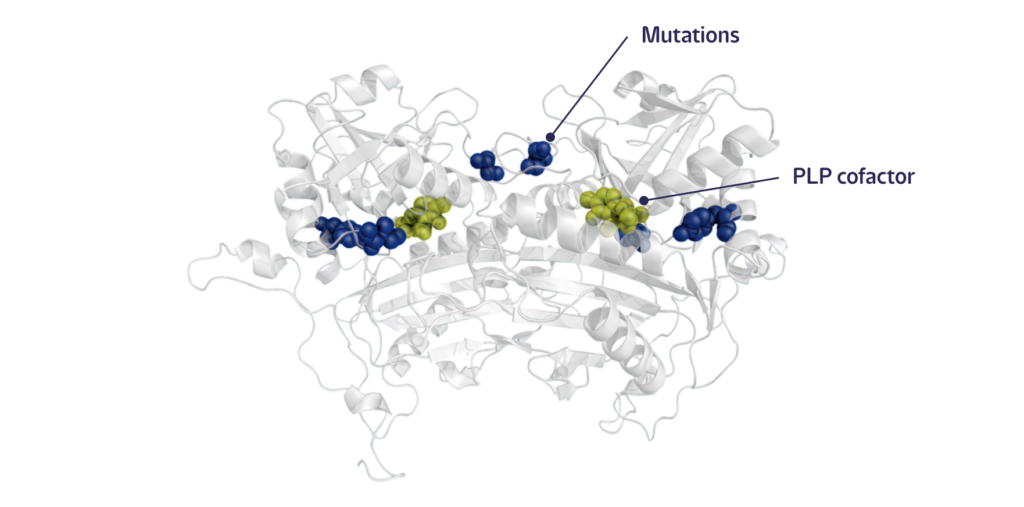
Structural model highlighting mutation positions in the target transaminase.
Image of the engineered transaminase showing the location of introduced mutations (dark blue) in relation to the PLP cofactor (yellow).
Our solution
To overcome these IP barriers in biocatalysis, Zymvol implemented a two-phase computational approach combining Enzyme Discovery and Enzyme Optimization:
-
- Enzyme Discovery
We began by computationally screening over 400,000 sequences, from which we managed to narrow down a selection of 16 top performers for laboratory validation. Out of the 16 sent to the lab, 6 enzyme hits were discovered. - Enzyme Optimization
Upon discovering 6 active hits from the initial 16, we set out to bridge the performance gap between the natural hits and the industrial biocatalysis requirements. Our team conducted 3 enzyme engineering rounds, testing only 300 mutants in the lab, a fraction of the effort required by traditional directed evolution methods.
- Enzyme Discovery
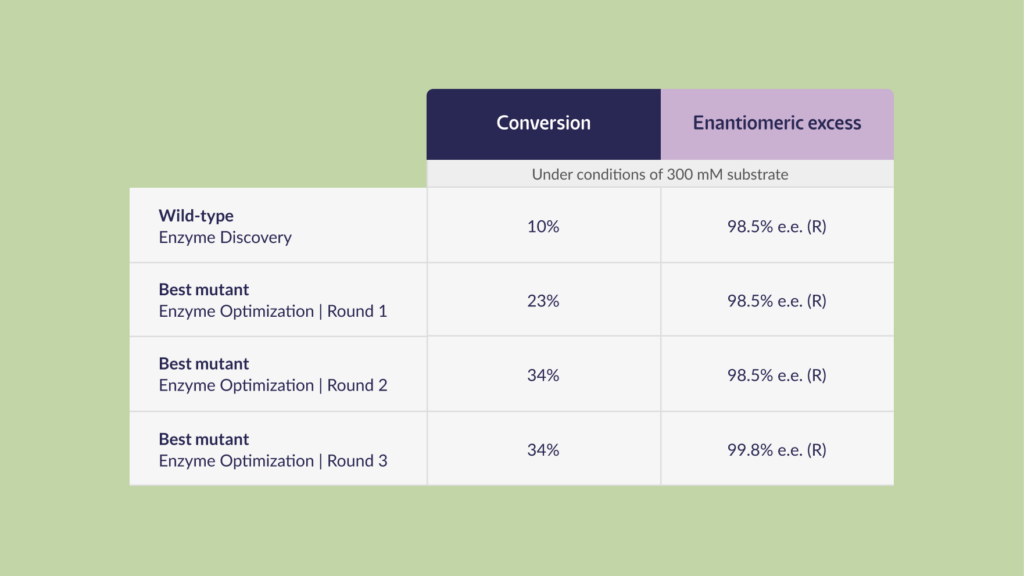
Performance summary of top enzyme variants.
Comparison of wild-type and optimized mutants over 3 rounds of engineering. Under high substrate load (300 mM), initial optimization rounds (1–2) successfully pushed conversion from 10% to 34%. Engineering priorities shifted in Round 3 to center on improving stereoselectivity to 99.8% e.e. (R).
Results & impact
- Outperforming commercial standards
The enzyme engineering campaign yielded a lead candidate that significantly surpassed existing benchmarks. Experimental validation confirmed that Zymvol’s top hit delivered 10x higher activity than the leading patented enzyme.
- Superior enantiomeric purity
Beyond activity, the precision of the engineered enzyme was significantly higher. While the leading patented enzyme achieved only 70% enantiomeric excess (e.e.), Zymvol’s best hit reached 99% e.e., meeting the stringent chiral purity standards required for high-quality API production. - Revitalizing “dead-end” projects
By delivering a high-performing, novel enzyme in just 3 rounds of engineering, Zymvol enabled the client to bypass 10+ IP barriers and recover a project that was previously headed for cancellation.
Performance Highlights10x
Activity
Our engineered hit outperformed the best patented enzyme available.
99%
Enantiomeric excess
Achieved near-perfect stereoselectivity, compared to only 70% from existing patented solutions.
3
Engineering rounds
A highly accelerated timeline, going from 400k sequences to a final optimized lead after testing only 300 mutants.
|
You might be interested in
Optimizing pharma manufacturing with a co-factor regeneration system
Zymvol’s team designed and implemented a novel enzymatic synthesis featuring an integrated co-factor regeneration system, allowing continuous in situ recycling of the cofactor rather than one-time use.
Turning wood waste into a sustainable industrial vanillin process via multi-enzyme cascades
Mapping distal mutations allowed us to extend the enzyme’s operational life by 40-fold, a critical factor for long-term industrial cycles.
Identifying a high-performing KRED for API synthesis
In a brief 30-minute reaction, the top performing enzyme achieved a 63% conversion to the desired chiral alcohol and delivered perfect stereoselectivity, meeting the stringent purity requirements for pharmaceutical ingredients.

From 1.5 billion sequences to high-performing enzymes in 2 months
The entire discovery-to-validation cycle was completed in a fraction of the time required for traditional approaches, dramatically de-risking the R&D process, lowering costs, and accelerating the timeline for bringing new products to market.
Delivering a 17x specificity boost in 6 months
After five intensive rounds of directed evolution, a leading biotech company had achieved an 8x increase in enzyme activity and a 12x increase in enzyme specificity. However, they had reached a plateau.
Improving artificial enzyme performance with distal mutations
By screening a small number of mutant enzymes, the team discovered two individual single distant mutations —located more than 11 Å from the active site— that significantly improved the enzyme’s properties.

Simpler oxygenated product synthesis by altering enzyme specificity
In only one month, we went from a highly specific bacterial peroxygenase to a versatile enzyme capable of hydroxylating both indole and thioanisole, two substrates it previously could not act on.