
The enzyme engineering campaign yielded a lead candidate that significantly surpassed existing benchmarks. Experimental validation confirmed that Zymvol’s top hit delivered 10x higher activity than the leading patented enzyme, as well as 99% e.e.
Food
Improving dioxygenases for sustainable vanillin production
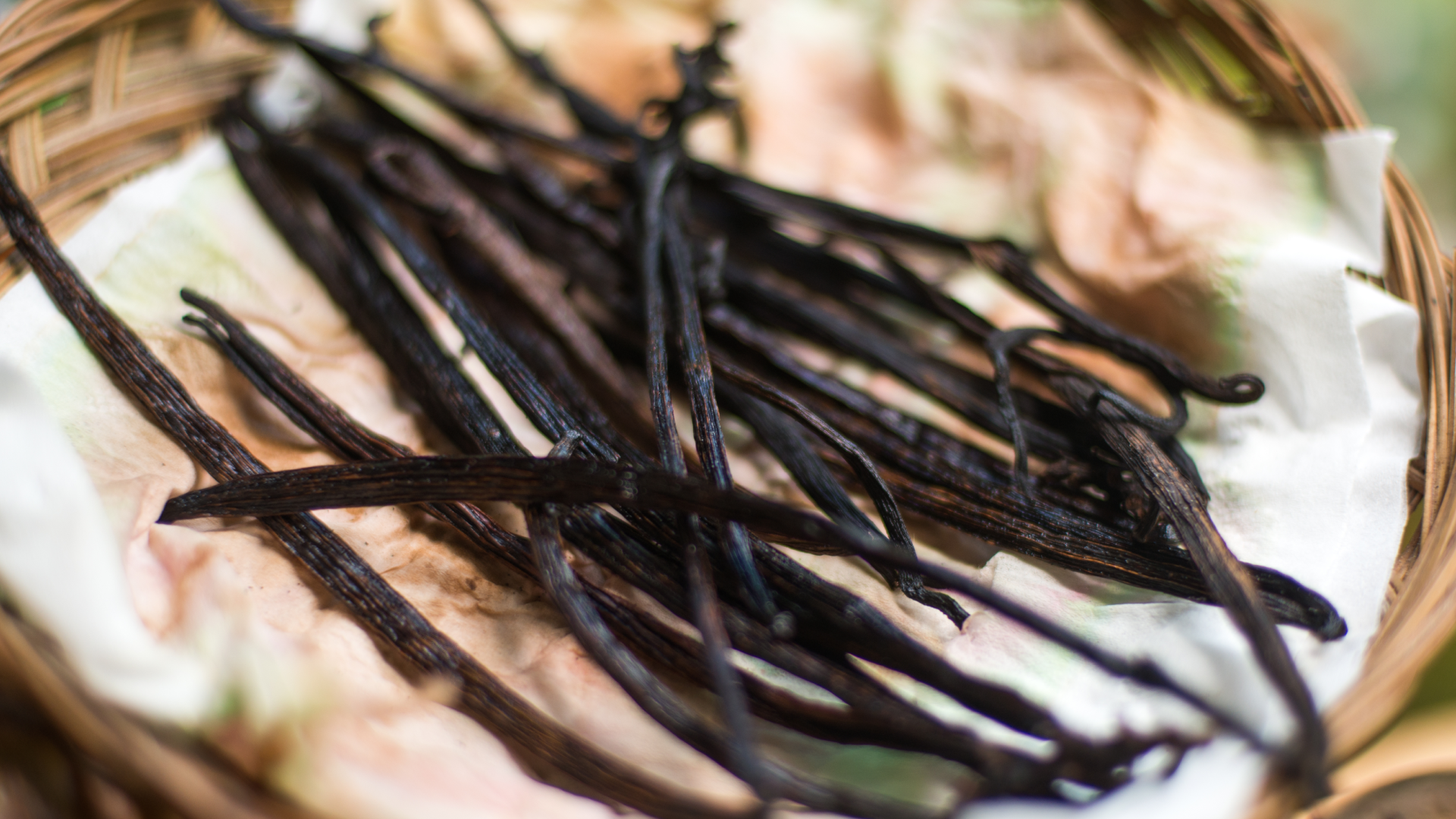
The Challenge: Moving Beyond Petroleum-Based Vanillin
Vanillin is one of the world’s most sought-after aromatic compounds, essential to the food, cosmetic and pharmaceutical industries. However, approximately 85% of global vanillin is currently produced via petroleum-based chemical synthesis, raising significant sustainability concerns.
Lignin, a renewable byproduct of the paper industry and one of the most abundant sources of aromatic carbon on Earth, represents a massive opportunity for sustainable vanillin production. However, to make lignin-to-vanillin conversion industrially viable, robust biocatalysts with enhanced catalytic activity and thermal stability are needed.
The Solution
In a joint effort with partners from the Smartbox and B-ligZymes projects, the consortium set out to select an enzyme capable of converting isoeugenol (a lignin-derived compound) into vanillin and engineer it to enhance its industrial application.
This project was divided in two phases:
Phase 1
Establishing industrial viability
During this first phase, the consortium decided to focus on NOV1, a dioxygenase enzyme capable of performing the conversion of isoeugenol into vanillin in single-step biocatalysis without the need for coenzymes.
A total of 35 variants were designed on the basis of the structural analysis of the NOV1 enzyme, in silico dockings, comparative structural alignments, and computation-based design, constructed and examined for activity toward the isoeugenol substrate.
Among these, one of them emerged as the most promising candidate: the S283F variant.
Results & Impact
- >99% conversion efficiency
The team achieved near-total conversion of isoeugenol to vanillin within 24 hours in enzymatic reactions.
- 4x improvement in oxygen-binding efficiency
A critical advancement for industrial processes where oxygen levels are often a limiting factor.
- Superior substrate tolerance
The variant successfully converted isoeugenol concentrations up to 100 mM—far surpassing current standard systems (10-20 mM).
- 20x longer half-life
Structural optimizations resulted in a 20-fold increase in stability and a 2x increase in turnover rate for isoeugenol.
- Scalable whole-cell catalysis
High efficiency (>99%) was maintained using whole-cell catalysis, significantly reducing purification costs and supporting industrial scalability.
Phase 2
Boosting performance with distal mutations
Following the success of the initial enzyme design, the next phase set out to maximize the enzyme’s operational stability and the catalytic constant by looking beyond the active site.
To achieve this, our team used Zymspot technology to identify 62 distal mutations located more than 10 Å from the active site. By targeting these specific regions, we were able to attain performance gains that are typically impossible to find through traditional random mutagenesis.
Results & Impact
- 40x operational stability
Mapping distal mutations allowed us to extend the enzyme’s operational life by 40-fold, a critical factor for long-term industrial cycles.
- 10x activity increase
Advanced DNA shuffling of the top 6 identified positions resulted in final variants with up to 10x the activity of the wild-type.
- Efficiency vs. random screening
While a parallel lab campaign of 3,000 random variants yielded only one hit (with lower activity than our starting point), our targeted mutagenesis study of just 41 single-point mutants yielded 9 superior hits.
Highlights
- x10 higher activity
Strategic engineering of the second coordination sphere and substrate entrance yielded a 10x increase in kcat compared to the wild-type enzyme. - 40x operational stability
Enzyme’s operational life was extended by targeting distal mutations located more than 10 Å from the active site. - Collaboration-driven innovation
A successful example of the strengths of consortium expertise to solve complex sustainability challenges.
✱ This Success Story summarizes the results presented in two peer-reviewed research papers published in Biochemistry and Journal of Biotechnology, co-authored by scientists from the European Projects Smartbox and B-ligZymes.
You might be interested in
Breaking IP barriers in API production
Delivering a 17x Specificity Boost in 6 Months
After five intensive rounds of directed evolution, a leading biotech company had achieved an 8x increase in enzyme activity and a 12x increase in enzyme specificity. However, they had reached a plateau.
Improving Artificial Enzyme Performance with Distal Mutations
By screening a small number of mutant enzymes, the team discovered two individual single distant mutations —located more than 11 Å from the active site— that significantly improved the enzyme’s properties.
Simpler oxygenated product synthesis by altering enzyme specificity
In only one month, we went from a highly specific bacterial peroxygenase to a versatile enzyme capable of hydroxylating both indole and thioanisole, two substrates it previously could not act on.